
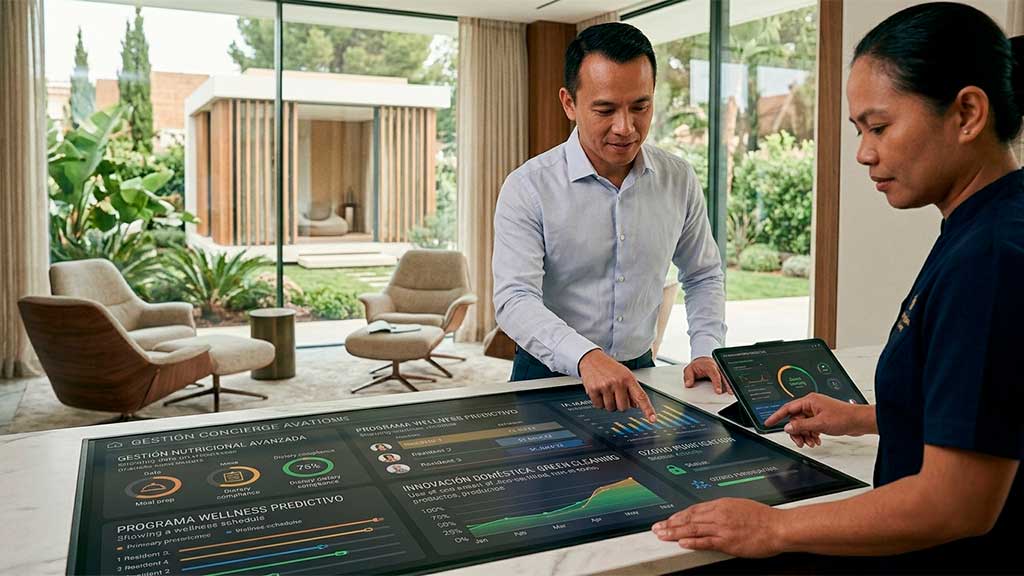
The concept of domestic service in the world’s most exclusive residences has ceased to be a purely assistive function or basic maintenance. Currently, we are facing a paradigm shift where home management aligns with the standards of corporate senior management and grand luxury hospitality. High-net-worth property owners are not just looking for staff to execute tasks, but for profiles with high technical qualifications, advanced digital competencies, and a superior emotional intelligence capable of anticipating any need. Assistance in high-end homes has transformed into a discipline of time optimization, privacy, and integral well-being. Throughout this analysis, we break down the macro-trends dictating the standard of excellence in this sector.
The integration of advanced technology and the “tech-savvy” profile
The contemporary high-end home is a hyper-connected ecosystem. Last-generation home automation, biometric security systems, and automated energy management require staff capable of interacting with complex digital environments without friction.
-
Expert management of integrated home automation ecosystems
Today’s domestic staff must master the interfaces that control everything from predictive climate control and circadian lighting systems to the property’s air and water filtration. A butler or an Estate Manager is no longer limited to visually supervising a room; they monitor control panels and coordinate software updates for residential systems. Mastery of these technologies ensures that the home runs autonomously, efficiently, and with optimized energy consumption.
-
Residential cybersecurity and digital privacy protocols
The protection of high-profile families is no longer limited to the physical perimeter of the property. With the proliferation of IoT (Internet of Things) devices, digital privacy is a critical priority. Current trends require trusted staff to be rigorously trained in cybersecurity protocols: from the secure handling of guest Wi-Fi networks to strict prohibitions on data or image leaks in digital environments. Traditional discretion has been completely digitized.
-
Predictive installation maintenance through artificial intelligence
Large estates increasingly rely on AI-based diagnostic systems that alert to mechanical anomalies before a breakdown occurs. The profile of the contemporary residential manager includes the ability to interpret these automated reports, scheduling visits from official technical services in a preventive manner. This avoids disruptions in the daily lives of the owners and preserves the value of the home’s material assets.
Subtle sustainability and high-impact waste management
Contemporary luxury is inextricably linked to ecological awareness. Operational guidelines in exclusive residences have been restructured to minimize the environmental footprint without sacrificing comfort.
-
Green cleaning and the elimination of toxins on noble surfaces
Maintenance cleaning has evolved toward the exclusive use of high-end biodegradable products and disinfection technologies using ozone or dry steam. Qualified staff—such as those exhaustively selected by Luxury Philippines D.S. Agency—possess deep knowledge of textile and material chemistry. They know how to treat rare marbles, precious woods, and haute couture fabrics without resorting to aggressive chemicals, protecting both the longevity of the materials and the respiratory health of the residents.
-
Domestic circular economy and food waste optimization
In high-end kitchens, private chefs and support staff implement advanced recovery and vacuum preservation techniques to reduce waste. Likewise, waste management includes knowledge of strict recycling regulations, domestic composting for private organic gardens, and the traceability of local suppliers. Sustainable luxury is now a silent but non-negotiable requirement.
Professional specialization and the rise of the asian management model
The demand for a highly specialized workforce has consolidated certain international profiles as the most coveted by global families due to their deeply rooted culture of respect and meticulousness.
-
The global preference for personnel of filipino origin
In the international market for premium assistance, personnel of Filipino origin continue to position themselves at the peak of demand. Their success lies in an exceptional combination of factors: bilingual mastery of English, specialized training in international protocol, and, above all, a natural warmth and emotional intelligence that facilitates harmonious cohabitation. Leading agencies like Luxury Philippines D.S. Agency act as the critical bridge to ensure these professionals comply with visas, legal regulations, and the highest service expectations in Europe.
-
The confluence between domestic wellness and personal assistance
Household employees no longer just maintain the space; they assist in their employers’ health goals. It is increasingly common for kitchen staff to be certified in functional nutrition, specific diets (paleo, keto, longevity), or for service staff to understand the fundamentals of biophilic design and the preparation of spaces for meditation, yoga, or private spa treatments within the villa itself.
Conclusion
The landscape of domestic service in high-end properties reflects society’s priorities: digitalization, sustainability, and an absolute focus on comprehensive well-being and mental health. Large properties no longer require simple operators, but residential managers capable of leading a complex environment with the precision of a five-star grand luxury hotel. Agencies that manage to understand this evolution and provide profiles that combine technological mastery with traditional service vocation—such as the highly sought-after Filipino staff—are the ones defining the standard of well-being and exclusivity in the world’s most demanding homes.