
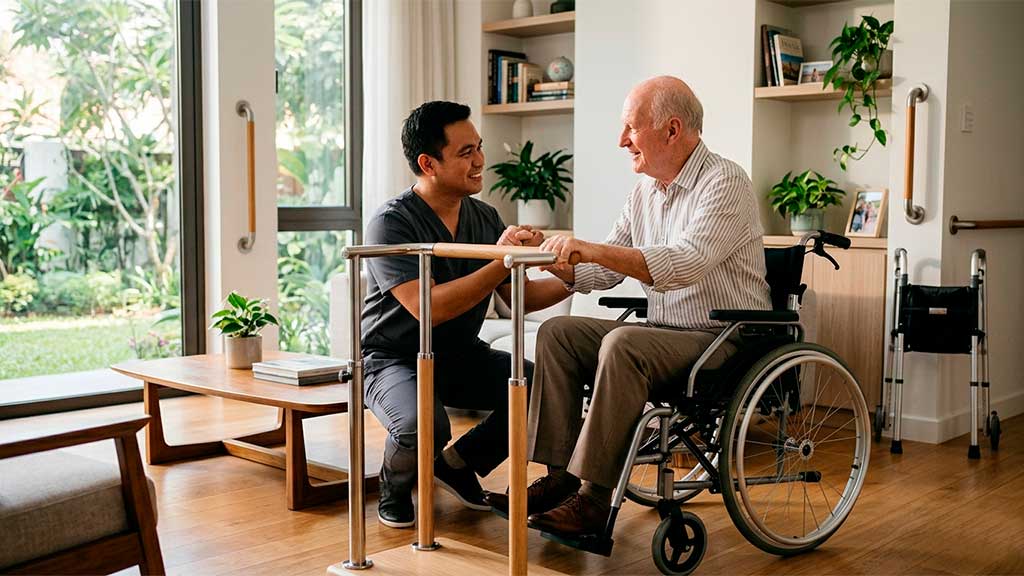
The true measure of quality of life at home, especially for individuals with reduced mobility or special needs, lies not only in safety but in the ability to preserve autonomy and dignity. In the field of high-end domestic service, care has evolved from simple physical supervision to comprehensive accompaniment that merges technical competence with deep motivational support. In this scenario, Filipino domestic staff have emerged as a global benchmark, not only for their rigorous training in physical assistance but for an innate cultural inclination toward empathy and a reverential respect for the individual’s identity, transforming the home into a space of empowerment.
Technical assistance: ensuring safety without restricting freedom
Mobility is a fundamental right that, when compromised, requires precise and adapted technical intervention. The goal is not to replace the person’s ability, but to complement it through the expert use of tools and techniques that minimize risk and maximize functionality.
-
Expert handling of technical aids and safe transfers
Staff selected by Luxury Philippines D.S. Agency have specific training in handling cranes, motorized wheelchairs, walkers, and standing systems. However, the technique is not limited to using machinery; it includes mastering manual transfers (bed-to-chair, shower-to-bidet) using correct body biomechanics to protect both the assisted person and the caregiver. This technical competence ensures that every movement is fluid, predictable, and free of anxiety for the individual with special needs.
-
Adaptation of the domestic environment and risk prevention
A critical part of technical assistance is the constant evaluation of the environment. Filipino staff are trained to identify subtle architectural barriers and propose practical adaptations: from reorganizing furniture to facilitate wheelchair turns, to installing non-slip surfaces and strategic grab bars. Fall prevention is a priority, but always under the premise of keeping the home a welcoming place, not a clinical one.
-
Passive physiotherapy and maintenance of functionality
Under the supervision of health professionals, support staff execute passive physiotherapy routines and range-of-motion exercises. These technical interventions are crucial for preventing contractures, improving circulation, and maintaining residual muscle elasticity. By integrating these routines into daily life in an enjoyable way, physical deterioration is slowed down, and the foundations for any potential gain in autonomy are laid.
The motivational pillar: fostering emotional autonomy and self-esteem
The technical aspect of mobility is sterile if it is not accompanied by an innate desire on the part of the person to continue interacting with their environment. Loss of mobility often leads to an erosion of self-esteem and progressive isolation. This is where the figure of the Filipino companion makes a qualitative difference.
-
Cultural empathy as a driver of motivation
Filipino culture possesses a deep connection with the concept of kapwa (shared identity) and an ancestral respect for elders and those with vulnerabilities. This cultural foundation allows the staff to connect emotionally with the person, understanding their frustration not as a behavioral problem, but as an expression of loss. This genuine empathy allows the caregiver to motivate without pressuring, celebrating every small achievement with sincerity.
-
Encouraging decision-making and active participation
Autonomy is not only measured in steps taken but in decisions made. Motivational staff ensure that the person with special needs maintains control over their daily life: from choosing their clothing to deciding on their walk’s itinerary. “Positive support” is used, encouraging the person to perform those parts of the task they can still execute by themselves, even if it requires more time. This reinforces the sense of personal competence.
-
Social accompaniment and preservation of community ties
Mobility is the key to social interaction. Filipino staff not only assist in physical transfers to medical appointments or family events but act as social facilitators. Their discreet and polite presence allows the person to participate in conversations and community activities without feeling like a burden, fighting the depression and isolation that often accompany physical disabilities.
Luxury philippines d.s. Agency: the link between excellence and human warmth
In selecting staff for people with special needs, technical competence is non-negotiable, but human quality defines the excellence of the service. At Luxury Philippines D.S. Agency, we understand that mobility support is an act of sacred trust.
We meticulously select Filipino professionals who not only demonstrate superior practical skills but possess that “vocation for service” inherent to their culture. Our candidates receive continuous training and are backed by an agency that prioritizes the dignity of the assisted person. By integrating a Filipino professional into your home, you are not just hiring a mobility expert, but incorporating a guardian of your loved one’s emotional autonomy.
Conclusion
Support in mobility for people with special needs transcends biomechanics; it is a holistic intervention that addresses human dignity. By merging rigorous technical assistance with motivational support rooted in cultural empathy, Filipino staff manage not only to move bodies but to lift spirits. At Luxury Philippines D.S. Agency, we are proud to be the bridge to this superior form of care, where technology and the heart work in unison to ensure that every person, regardless of physical limitations, can live a full and autonomous life in the sanctity of their home.